Dry-Eyed Drop-offs
It’s back-to-school season, and whether you’re dropping your child off for their first day of kindergarten or their first day of college, emotions are real, and not just your child’s. It’s okay to feel anxious about this next big step; however, it’s your job to keep your emotions in check and to convey to your child that everything is going to be alright. While I was fortunate enough to have my kids in school with me for many years, I can still feel the butterflies in my stomach that were dancing around on Maddee’s first day of 7th grade, and Max’s first day of high school, and they were teenagers at that point! Don’t even get me started on the college drop-off; like my dad before me, and despite best efforts to follow my own advice, I sobbed during college drop-off for both kids.
You know the Elizabeth Stone quote, “Having children is to decide forever to have your heart go walking around outside your body.” The first day of school is one of those moments when you can really feel that vulnerability. Your child is launching out on their own, and you aren’t going to be there to see what unfolds.
Over the years, I’ve watched countless parents and children struggle to separate during those first days of the new school year. This is normal. Saying goodbye even for a few hours is hard! Every parent-child relationship is unique, but there are some proven strategies that can help make separation easier for both you and your child.
Exude confidence. Your child, regardless of their age, will take their cues from you. If they know that you are comfortable with the school, the teachers, and the administration, they will build on that confidence. If you show that you are apprehensive or scared, you’re showing them they should be, too. It’s okay for you to feel anxious or sad, but try your best to stay composed until your child is out of sight.
Acknowledge your child’s fear or apprehension. Don’t be dismissive, but don’t be indulgent either. Listen, help them name it, let them know it’s a normal feeling. My friend Nikki reminds her children that anxious and excited feel the same way in your body, and you get to decide which one it is. You can also support your child by finding a connection point or something to look forward to. It may be a reminder about something they like about school, or it may just be letting your child know that you’ll see them at the end of the day. Word of caution: Don’t promise your child something if you aren’t sure about it. For example, I’ve heard parents promise children that they will see a favorite teacher or friend, not knowing that person is out with the flu. Now you’ve just inadvertently broken a promise to your child!
Remember that you and your child are not the same person. If you had a difficult time at school, whether socially or academically, my heart goes out to your younger self, truly. But you can’t let that younger self whisper past heartaches in your ear as you navigate your child’s experience. As a general rule, your inner child shouldn’t be ignored; sometimes, though, you need to give them a lollipop, ask them to sit quietly for a moment, and let your grown-up self handle this one.
Speaking of lollipops, avoid bribing your child to get them through the door. Bribery works for a day or two, but it doesn’t solve the situation, and it’s not sustainable. I promise you that on day four, when your child is three cupcakes deep before 8:00 am, you’re going to be questioning your strategy. Trust me on this.
A quick separation is a healthy separation. Don’t linger. Keep your goodbye ritual to under 30 seconds: a hug, a well wish for the day, and off they go. More importantly, off you go. I know it’s hard, but dragging out the goodbye is a signal to your child that you’re apprehensive or afraid. Don’t do that. See number one.
At the same time, a quick goodbye doesn’t mean an unengaged goodbye. Your child deserves your attention; you should be present. Don’t be on your phone during drop-off, even if it means rescheduling that important work call.
Respect the boundaries the teacher gives you. This includes the designated drop-off point. If your school does a car line, use the car line. If your school suggests dropping off at the door rather than walking your child to their room, do that. Teachers are in this business for a reason. Trust their ability to console your child. I’ve seen many teachers work absolute magic when consoling a child. Leave it up to the experts.
Trust your child. You already know your child is capable and smart. Now you just need to trust that. The first few days may very well be bumpy, but they may be smooth. Trust your child to navigate what comes their way. While you’re at it, trust your own ability and parental instincts. Keep communication open to ensure that if something isn’t going well, you will find out about it. My friend Chelsea always had her children share a high and low after school every day. They did this all the way through high school. It’s a great habit to get into right away and a great window into their day.
If your school doesn’t already offer it, organize a boo-hoo breakfast. Plan a coffee shop outing with a few other parents. Meet up after that first drop-off to cry, laugh, and console. While you should hold it together in front of your child, afterward you are encouraged to lean into your emotions. Some schools already have an event like this organized for parents, but if not, you can create one yourself. When we dropped Max off at college, Lewis and Clark did a Tissues and Tears happy hour for parents. It was timed just right and really a perfect place to let the tears fall and the wine flow. This was an evening event; I recommend a latte over the glass of wine if you’re doing a breakfast, but then again, I won’t judge.
Ask for help. Sometimes we need to get a little creative. You are trying for the 30-second drop-off, but your child is glued to your leg and sobbing. How could you possibly leave them? You can. You should. And it’s okay to ask for support. Whether that’s getting the eye of a school employee and letting them take over, or asking another parent if your child can walk in with their child, sometimes we need to enlist the village. That’s okay!
You can always call the school to check in. Yes, they are busy. No, it shouldn’t be a daily habit. Still, as noted before, school employees are highly empathetic. They’re there for the children and are typically happy to take a minute to peek in on a child and see how they’re adjusting. I tell parents to wait thirty minutes and call the school to check in. Most of the time, your child has settled in by then, and that’s just the reassurance you need to get through your day.
Remember, your child is the child, and you are the grown-up. It’s natural to feel emotional about this milestone, but try not to make your child responsible for taking care of your feelings. This is their first day, and they need to know that you trust them to take this next step. You can miss them terribly and still send them off with confidence. Now take a deep breath and know it’s going to be okay!

Maddee and Max 2006. First day of kindergarten and first day of preschool.
Take a Hike
Our family loves to hike. We love stopping and looking at plants and mossy rocks. We love coming across an unexpected waterfall or even a gentle cascade. We love walking in silence, and we also love being chatty. (Okay, I love being chatty). And sometimes, sometimes we also love playing games.
Here are five hiking games/activities that I’ve played with my family and also with my students over the years. Give one a try. They’re so much fun, and a good distraction if your legs are getting tired and your feet are getting sore.
Camouflage
This is a fun and easy take on hide-and-seek. The person who is “It” covers their eyes, yells Camouflage and then counts to twenty. Everyone scatters and tries to hide behind something (a tree, a rock, a field of flowers). The trick is doing so without causing harm to the trail. The last person to be found is now it.
Flash Flood
Someone is “It” and at any time can shout “Flash Flood!” As soon as the other hikers here that they find something (a rock, a log, a stump) to jump on. The last person to find something is now it. Of course, we all have that game director who’d much rather be “It” and will wait to be last to hop up on something. You’re clever, you’ll find a way to modify that part.
Scavenger Hunt ABCs
Try to find something on the hike for each letter of the alphabet. It’s just that simple and takes a good amount of time. Variations–how many things can you find of a certain color? Shape? Etc.
Mindfulness Walk
Spend part of your time doing a 5-4-3-2-1 mindfulness walk. We just did this on a recent hike and it was really centering, and forced me to be quiet for a bit. 😀You can set a timer and do this for even just 5-10 minutes.
5 things you can see
4 things you can hear
3 things you can touch/feel
2 things you can smell
1 thing you can taste
Have everyone report back whatever they remember when you’re done.
Contact (3-2-1 or 1-2-3 depends on who you ask)
This isn’t just a hiking game; it’s an "anywhere" game, but hikes are a perfect place to play because a round can last as long as you want. You need at least three players.
One player is the Wordmaster. They choose a secret word and announce only its first letter. For example: "My word starts with P." (The secret word is Potato.)
The other players work together to discover the word.
One player asks a question, such as, "Is it a color?"
If another player thinks they know exactly what word that question was hinting at, they yell, "Contact!"
Those two players count down together: "3...2...1..." and say their word at the same time.
If they both say the same word (for example, "purple"), the Wordmaster must reveal the next letter of the secret word. In this example, the clue changes from P to PO.
If the two players say different words—or if the Wordmaster correctly guesses their word before they say it ("blocks" them)—nothing happens, and play continues.
At any time, a player may guess the secret word. If they're correct, they become the next Wordmaster. If they're wrong, play simply continues. The challenge is coming up with clues that another player will understand—but the Wordmaster won't figure out in time to block.
What games have you played on hikes? Drop them in the comments and then, go on and take a hike!

Can you find me? ◡̈
Sometimes We Go in Circles
Sometimes we think we’re moving forward. Getting closer to our goal, only to find that we’re actually just going in circles.
Many of you know I grew up in the Boston area, but that doesn’t mean I’m familiar with all the towns, neighborhoods etc. Far from it. Last weekend, I was back in the area and doing a housesit on the Somerville/Medford line, not too far from Tufts. I planned a ten-mile run that would take me into Cambridge and eventually along the Charles River. I added all the coordinates into my Apple Maps. Now all I had to do was walk out the door, down the front stairs, and follow the map cues. Easy! The first two miles were a slog; it was hard to get into my rhythm, especially with so many street crossings. But I reminded myself that some of the best long runs kick off with a less-than-stellar start. I decided to stop and take a photo of a cool landmark, and somehow, unbeknownst to me, I did something to my Maps in the process.
Back on my route, I must be in Cambridge by now, I rounded a corner and saw a few Tufts buildings. Huh. I didn’t realize this campus was so sprawling. And then, I saw the sign. The street sign. My brain started to ache a little as I tried to put the pieces together. I turned on the street, just as Apple told me. And on that street sat a particular house, and, you guessed it, it was my house–well, at least my house for the weekend. Somehow, I ended up back at the start, with only a little over three miles completed out of ten. I’d just, quite literally and unknowingly, run in a circle. I still had seven miles left to go, and I was back at square one! My spirits were shot. But did I give up? Did I throw in the towel? Call it quits? Umm, yes. Yes, I did. I went back into the house, grabbed my wallet, and walked to the cafe around the corner. But that’s not the point of this particular story.
Going in circles is so frustrating. I spent the better part of the morning reviewing my map. And, looking at the bird’s eye view, I can see exactly where I got turned around and started to run in a circle, but in the moment, I really thought I was moving forward. And that, my friends, brings me to the point of this particular story. You knew there was a point!
As educators and school leaders, we sometimes find ourselves going in circles. We expect we’d be further along with a strategic initiative, but we find ourselves putting out fires. We want to honor all voices, but then decisions suffer from death by committee. We think we are on the same page with a family about their child, but then we realize, we most certainly are not. In these times, we feel off track, overwhelmed, and short on time. We feel like we’re underperforming. We feel judged.
So how do we stop chasing our tail and get back on track? Here are a few things that work for me:
Slow the pace.
Occasionally, we need to slow down to be able to recenter and remember our purpose. Our brains are computers, and they need us to pause, or even fully reset, for system optimization. If your computer is like mine, you have way too many tabs open; our brains can be that way, too. So, take some time to slow down and close some tabs. I know I make more mistakes when I’m feeling hurried and have too many things going on at once. Even when your to-do list feels very long, slowing down could be just what you need to get back in the game and do things well.
Reflect on your goals.
Where we are going is important, but remembering why we’re going there in the first place can be exactly what we need to get back on track. Pull out that strategic plan, or your personal goal list, or your students’ portfolios. Let’s remind ourselves to lean into our “Why”s. Otherwise, what’s the point?
Get up on the balcony.
We need to see the entire scene. We know this! Just as I needed to see the map of my route to see where I started going in circles, we need to see the entire scenario. Once we’re up on the balcony, we can make some adjustments and come back down to the main stage.
Focus on what’s important in the moment.
The work we do, it’s all important. Even if it doesn’t feel like it. Giving something only half our focus because we have other priorities is only going to make that thing twice as much work in the long run. It’s just the way it is. So, yes, even if you find yourself plunging a toilet (and don’t we all end up with that skill at some point when we work in schools?), remember, focusing on this right here and now will help you focus on the bigger things later in the day (and will save you a few dollars on a plumber!).
Talk to a colleague or mentor.
Hands down, this is one of the best ways for me to be able to get back on track. First, I’m reminded that I’m not alone and these problems aren’t unique to just my classroom or my school. Second, listening to myself explain what’s going on allows me to see things from a different angle, and lastly, having someone really listen and share strategies is an invaluable gift.
Breathe and try again.
Whether it’s a long breath: a day, or even a week, or it’s just a few minutes, take the time you need and then jump back on course. You’ve got this.
Sometimes we go in circles, but with intention and purpose, we can always find our way back to our path.

The Powder House Mill, aka the place where I stopped for a photo and then ended up going in a big, fat, circle.
That Darn Imposter Syndrome
Some of my best self-reflecting is done on the run.
Today on my run, I was trying to figure out why, after years and years of being a school leader, I feel a bit apprehensive about letting people know that I’m doing consulting work. I’ll tell you one thing, self-consciousness is not a good marketing strategy. I think part of it is that I didn’t do my job perfectly. I often did it well and always with lots of love, but I didn’t always get it right. It wasn’t perfectly smooth. How can I pitch a product, in this case me, when it’s not perfect? It’s a knock-off, an imposter.
Many people have experienced imposter syndrome. This is the idea that we aren’t nearly as competent and intelligent as people perceive us to be and at any moment the curtain will be lifted and they’ll see who we really are. I believe in strengths-based leadership and growth, yet here I am, in my head, focusing on how I’m “less than.” Relatable?
The other day on the phone I said something about imposter syndrome to my friend, Sara. Sara told me to thank that little voice that is telling me I’m not good enough, because it must have helped me in some way at some point, maybe that was to push myself differently or clarify a goal. Now, it’s not helpful. It’s time to let it go. Kick it to the curb. See you later, alligator.
Reality says that I am a subject matter expert. When I partner with a school community, I’m ready to share what I know, research what I don’t, and put my own past mistakes on the table, so we can learn from them together.
I can’t promise that little voice is gone forever, but for today I have sent it on its way. And that feels good!
Chances are many of you have encountered imposter syndrome, too. Here are some tips that can help us counter that feeling and grow our toolbox for the next time:
Challenge the critic
Why are you criticizing yourself? What proof do you have that you aren’t good enough? Probably not much at all. So stop!
Rely on objective evidence to evaluate yourself and to reflect on your abilities. How many times have you gotten it right? A lot. I know it. Acknowledge it.
Are your expectations for yourself realistic? Maybe it’s time to recalibrate them. It’s not lowering the bar, it’s giving yourself some much needed self-care.
Friend, you’re not the only person on planet Earth who makes mistakes, loses their words mid-presentation, wishes they said just the right thing in that parent meeting. That doesn’t make you an imposter. It makes you human.
Accept and internalize acknowledgments
Next time someone tells you that you are doing a good job, listen. Maybe even ask them what specifically they appreciated. Yes, gather more external evidence to contradict that silly little voice who says you don’t know what you’re doing.
Accept constructive feedback, too. It’ll help you grow.
I know this sounds a little contrary, but when we actually accept constructive feedback we know where to improve. Instead of a binary approach, I’m either great at everything or terrible at it, look for the areas that need a little shining. Rely on your many strengths to help you shape up those weaknesses.
Treat yourself the way you treat others–with love, respect, and compassion
How mean are you to yourself compared to how you treat others? I would never say some of the things out loud to another human being that I so easily say to myself. Get over it! Be. Kind. To. Yourself. Please!!
If all else fails, curl up under a blanket and remember tomorrow is a new day
Somedays you just need to grab that chocolate peanut butter ice cream, a spoon, and a blanket, and give in. But, make sure those days are few and far between. You’re fantastic! You wouldn’t be doing what you do if it were otherwise.
Five Tips for Decreasing Stress this Spring
It is certainly that time of the year. We’re a few days into May and time is going to fly! No matter how well you’ve planned that calendar, and how serious you are about self-care, the end of the school year can be intense! Here are five quick and easy ways to destress and, dare I say, add joy in tough moments.
Make a playlist
It doesn’t matter if you listen to Luciano Pavorati or Blackpink, or both. Listening to music can help center you. Maybe it’s the 80s kid in me, and my love of mixed tapes, but I find even the act of creating a playlist brings me joy. Make that list and then crank it up on your way into school, on your way home, or even in the classroom. In fact, having your students help you create a joyful playlist is a great community building activity. They can help you decide on the when (we play this during lunch, during transitions, when we all need to destress), and maybe introduce you to your future favorite artist. Word to the wise, do a lyric check before hitting play!
2. Go outside, go outside, go outside
As an administrator, I love recess duty. Let me rephrase that, I love recess duty when it’s warm and sunny out. I’ll raise my hand so high to help with coverage during these spring days. There’s something to be said for going outside even for five minutes. Just a few minutes outside can regulate your thinking, boost your mood, and provide much needed perspective. I’d even say this works on rainy days, but I might be fibbing.
3. Tag out
As an educator, you know this is a tool we all need sometimes. So are you using it? Whether you are a classroom teacher, an administrator, or support staff, it really doesn’t matter. It’s okay to raise your hand and ask for help. We’ve all done it, we’ve all needed it, and guess what, it’s ultimately best for everyone. Tagging out helps you catch your breath, think more clearly, and be your better self. And isn’t that who we always want to be?
4. Move your body
You know that moving your body is imperative for physical and mental health. You probably tend to this in the form of structured exercise. However, you can (and should) be moving your body all the time. Stand up, do a lap around your classroom or office. Pace, twist, stretch, jog in place, it doesn’t really matter. Moving is regulating. You know this, now do it!
5. Phone a friend
I have a list of people in my network who I can call with a specific question or if I just need to whine. I also have friends outside of work who I can lean on when things feel stressful. A great hack for me is to call someone who makes me laugh. I don’t even need to discuss why I’m down, just hearing their voice and having a moment of laughter is a great distraction. If you have a longer commute and need a break from that great playlist you created, you have the perfect opportunity to phone a friend. Can’t think of anyone to call? You can call me!
What do you do to de-stress during the harried days of spring? Comment below!

This is a photo of me in spring of 2020. Talk about a stressful time in education! I obviously forgot to practice the five tips in this post!
From Knees Knocking to Conference Talking
Lessons on public speaking from mentors, mistakes, and a lot of shaky nerves.
I was once petrified of public speaking. A common, and in my humble opinion, very reasonable fear.
Now, I actually enjoy it.
In fact, talking with other educators about our practice, about joyful education, about mistakes and learning, is one of my favorite things to do.
So how did I get from knees knocking and shaking like a leaf to comfortably addressing a room full of people? Well, like so many success stories, I had a goal, a vision, and a boatload of help.
1. I listened to the wisdom of Diana Butler.
I mean, who wouldn’t? For those of you who know Diana, enough said, right? But for those who don’t, let me invite you in.
Diana was an instructor for many years at a teacher education program where I also worked. My course, Cosmic Education, followed Diana’s Montessori Philosophy course.
I ran into Diana in the parking lot on my first day. She was walking to her car, and I was unloading bins of materials. Diana’s white hair was blowing in the breeze, and she stood tall and confident.
Meanwhile, there I was: curls going in every direction, and my skirt taking that same breeze as an opportunity to threaten to expose me.
And I mean literally.
My hands were full of bins, fossils, model skulls, and little clay planets. I may have been sweating. I may have been slightly green.
Whatever it was, Diana took notice and saw a gal in need.
I confessed that I was nervous. Teaching children was one thing, but being up in front of a group of adults, adults who expected me to be the expert, felt overwhelming.
Diana laid one palm on my arm and told me that on her first day teaching adults she had wanted to curl up in a ball under a blanket.
Instead, she reminded herself that she had been hired because she had expertise to share. She knew what she was doing. And the people in that room were there to learn from her successes and her mistakes.
Then she said the ten words I really needed to hear:
If all else fails, fake it till you make it.
Hey, sometimes that’s magic.
2. I worked with a coach.
As Head of School, I had to speak in front of groups of teachers and parents often. Speaking with teachers was easy for me. Presenting to parents was a totally different animal.
I was often a shaky, sweaty mess.
I knew the school so well. I knew Montessori education so well. I wanted to express that, but my nerves kept getting in the way.
So I asked my Board of Trustees if we could invest in a coach. It ended up being one of the best professional decisions I ever made.
I worked with a local woman named Deborah Olive. She was more polished than I was and definitely more serious. At first, she seemed a little removed, but I soon realized she was warm, deeply committed to pushing me, and determined to see me succeed.
With Deborah, we worked on posture, what to do with my hands (you know, awkward hanging hands or the distracting tornado hands), and how to own the room.
She once told me my job wasn’t to calm down when I was nervous. My job was to channel that energy from anxiety into enthusiasm.
It helped.
She also required me to watch videos of myself. Eeek. She required me to finish my homework. Everyone is busy, she would remind me. Being busy is not an excuse.
She made me face my challenges and embrace my strengths. My speaking and presentation skills noticeably improved.
3. I channeled my inner Laurie O and Lisa L.
Two of my favorite Montessori presenters just happen to be people I am honored to call friends.
At least a decade before I braved presenting at conferences, Laurie and Lisa were already doing it comfortably. No matter the topic, I never missed their presentations. I was, and still am, a fangirl.
There are a few reasons I love their presentations.
*They know their stuff. They are way smarter than I am. I honestly don’t know how they hold that much information in their brains. I really don’t.
*They are funny, but in completely different ways.
Lisa’s humor is dry wit. Sarcastic. Loving teasing. She is direct, unpretentious, and somehow puts everything together in a way that makes you immediately want to be her best friend.
Laurie’s humor is a bit sillier. She moves and flows with it. It is physical, not falling-over-the-couch physical, but almost dance-like. And there is no one who laughs at herself quite like Laurie. She is just fun. And she knows what a fangirl I am and likes me anyway.
*But most of all, they are comfortable in front of a group. There is no people-pleasing. No awkward body language. Just presentation, engagement, and learning.
Bottom line: they are so cool.
I want to be that.
4. I read a few books that helped.
No shade to the authors, of these two books, but I was not wowed by the covers or drawn in by the synopses. Still, I read them because people I trusted recommended them. So I will pass them along to you.
Butterflies Be Gone: A Hands-On Approach to Sweat-Proof Public Speaking by Dr. Arthur Bell
You’ve Got to Be Believed to Be Heard by Bert Decker
They are not the most riveting books in the world, but they made a difference for me.
5. I learned a little about the physiology of the fear of public speaking.
It may have actually been the Butterflies book that first got me interested in this idea. I believe Dr. Bell addresses this. Public speaking fear takes us straight back to the reptilian brain. You know the one. Fight, flight, or freeze.
When that part of the brain activates, the prefrontal cortex, the thinking part, goes offline. If you have a fear of public speaking, your brain thinks you’re being threatened. It thinks your life is in danger!
If your mode is freeze, you might stand up in front of the group and forget absolutely everything you planned to say.
If your mode is flight, your body desperately wants to run off the stage. Since you cannot actually run, you avoid the audience. You mumble, stare down at your notes, or read without expression.
And if your mode is fight, you might speak too loudly, too quickly, and physically shake.
Your brain thinks you need to punch something. But you cannot. So all that adrenaline spills out wherever it can, essentially turning you into a milkshake.
I was surprised to identify with fight mode. I am such a peaceful chick. Apparently, my nervous system disagrees.
But knowing that gave me power. My body is not betraying me. It is trying to protect me.
So now I do a few things to help it along:
I walk around before presentations. I do laps. I greet families. I move my body.
2. During presentations, I move a little, purposefully, not frantically.
3. And if I really cannot get it together, I choose my props wisely. Maybe I ask for a headset mic instead of a handheld. Maybe I hide the shaking knees under a long skirt. Maybe I mosey behind a podium for a minute until I feel more regulated.
And of course, deep breaths. It is always deep breaths, right?
6. I threw myself into the fire.
I applied to present at a national conference. I was accepted. I did it, and it was well received.
The next year, I did another.
And then another.
And another.
I still get nervous sometimes. I still get a little shaky here and there.
But most of the time?
I love it.
And it turns out Diana was right.
Sometimes you really can fake it until you make it.
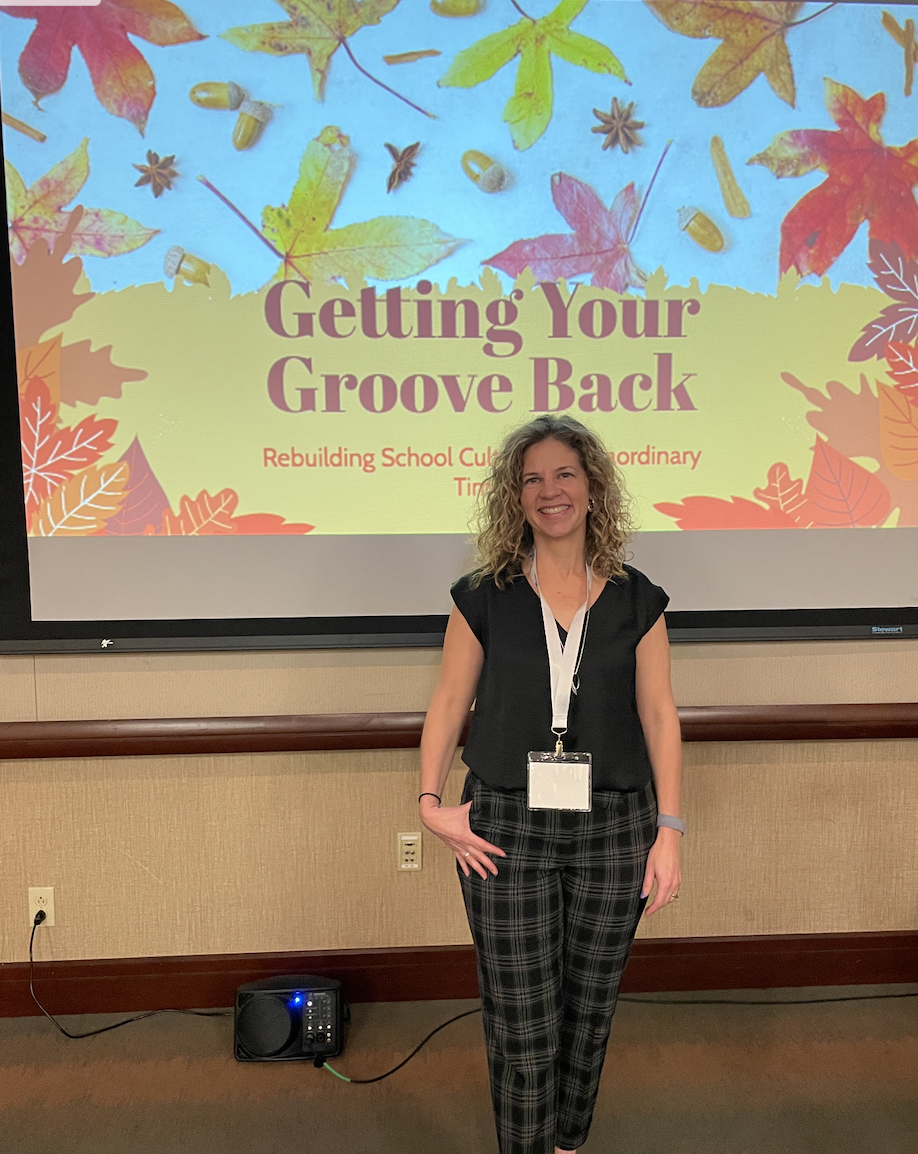
A great day in St. Louis presenting at the HOPE Montessori conference in 2023