From Knees Knocking to Conference Talking
Lessons on public speaking from mentors, mistakes, and a lot of shaky nerves.
I was once petrified of public speaking. A common, and in my humble opinion, very reasonable fear.
Now, I actually enjoy it.
In fact, talking with other educators about our practice, about joyful education, about mistakes and learning, is one of my favorite things to do.
So how did I get from knees knocking and shaking like a leaf to comfortably addressing a room full of people? Well, like so many success stories, I had a goal, a vision, and a boatload of help.
1. I listened to the wisdom of Diana Butler.
I mean, who wouldn’t? For those of you who know Diana, enough said, right? But for those who don’t, let me invite you in.
Diana was an instructor for many years at a teacher education program where I also worked. My course, Cosmic Education, followed Diana’s Montessori Philosophy course.
I ran into Diana in the parking lot on my first day. She was walking to her car, and I was unloading bins of materials. Diana’s white hair was blowing in the breeze, and she stood tall and confident.
Meanwhile, there I was: curls going in every direction, and my skirt taking that same breeze as an opportunity to threaten to expose me.
And I mean literally.
My hands were full of bins, fossils, model skulls, and little clay planets. I may have been sweating. I may have been slightly green.
Whatever it was, Diana took notice and saw a gal in need.
I confessed that I was nervous. Teaching children was one thing, but being up in front of a group of adults, adults who expected me to be the expert, felt overwhelming.
Diana laid one palm on my arm and told me that on her first day teaching adults she had wanted to curl up in a ball under a blanket.
Instead, she reminded herself that she had been hired because she had expertise to share. She knew what she was doing. And the people in that room were there to learn from her successes and her mistakes.
Then she said the ten words I really needed to hear:
If all else fails, fake it till you make it.
Hey, sometimes that’s magic.
2. I worked with a coach.
As Head of School, I had to speak in front of groups of teachers and parents often. Speaking with teachers was easy for me. Presenting to parents was a totally different animal.
I was often a shaky, sweaty mess.
I knew the school so well. I knew Montessori education so well. I wanted to express that, but my nerves kept getting in the way.
So I asked my Board of Trustees if we could invest in a coach. It ended up being one of the best professional decisions I ever made.
I worked with a local woman named Deborah Olive. She was more polished than I was and definitely more serious. At first, she seemed a little removed, but I soon realized she was warm, deeply committed to pushing me, and determined to see me succeed.
With Deborah, we worked on posture, what to do with my hands (you know, awkward hanging hands or the distracting tornado hands), and how to own the room.
She once told me my job wasn’t to calm down when I was nervous. My job was to channel that energy from anxiety into enthusiasm.
It helped.
She also required me to watch videos of myself. Eeek. She required me to finish my homework. Everyone is busy, she would remind me. Being busy is not an excuse.
She made me face my challenges and embrace my strengths. My speaking and presentation skills noticeably improved.
3. I channeled my inner Laurie O and Lisa L.
Two of my favorite Montessori presenters just happen to be people I am honored to call friends.
At least a decade before I braved presenting at conferences, Laurie and Lisa were already doing it comfortably. No matter the topic, I never missed their presentations. I was, and still am, a fangirl.
There are a few reasons I love their presentations.
*They know their stuff. They are way smarter than I am. I honestly don’t know how they hold that much information in their brains. I really don’t.
*They are funny, but in completely different ways.
Lisa’s humor is dry wit. Sarcastic. Loving teasing. She is direct, unpretentious, and somehow puts everything together in a way that makes you immediately want to be her best friend.
Laurie’s humor is a bit sillier. She moves and flows with it. It is physical, not falling-over-the-couch physical, but almost dance-like. And there is no one who laughs at herself quite like Laurie. She is just fun. And she knows what a fangirl I am and likes me anyway.
*But most of all, they are comfortable in front of a group. There is no people-pleasing. No awkward body language. Just presentation, engagement, and learning.
Bottom line: they are so cool.
I want to be that.
4. I read a few books that helped.
No shade to the authors, of these two books, but I was not wowed by the covers or drawn in by the synopses. Still, I read them because people I trusted recommended them. So I will pass them along to you.
Butterflies Be Gone: A Hands-On Approach to Sweat-Proof Public Speaking by Dr. Arthur Bell
You’ve Got to Be Believed to Be Heard by Bert Decker
They are not the most riveting books in the world, but they made a difference for me.
5. I learned a little about the physiology of the fear of public speaking.
It may have actually been the Butterflies book that first got me interested in this idea. I believe Dr. Bell addresses this. Public speaking fear takes us straight back to the reptilian brain. You know the one. Fight, flight, or freeze.
When that part of the brain activates, the prefrontal cortex, the thinking part, goes offline. If you have a fear of public speaking, your brain thinks you’re being threatened. It thinks your life is in danger!
If your mode is freeze, you might stand up in front of the group and forget absolutely everything you planned to say.
If your mode is flight, your body desperately wants to run off the stage. Since you cannot actually run, you avoid the audience. You mumble, stare down at your notes, or read without expression.
And if your mode is fight, you might speak too loudly, too quickly, and physically shake.
Your brain thinks you need to punch something. But you cannot. So all that adrenaline spills out wherever it can, essentially turning you into a milkshake.
I was surprised to identify with fight mode. I am such a peaceful chick. Apparently, my nervous system disagrees.
But knowing that gave me power. My body is not betraying me. It is trying to protect me.
So now I do a few things to help it along:
I walk around before presentations. I do laps. I greet families. I move my body.
2. During presentations, I move a little, purposefully, not frantically.
3. And if I really cannot get it together, I choose my props wisely. Maybe I ask for a headset mic instead of a handheld. Maybe I hide the shaking knees under a long skirt. Maybe I mosey behind a podium for a minute until I feel more regulated.
And of course, deep breaths. It is always deep breaths, right?
6. I threw myself into the fire.
I applied to present at a national conference. I was accepted. I did it, and it was well received.
The next year, I did another.
And then another.
And another.
I still get nervous sometimes. I still get a little shaky here and there.
But most of the time?
I love it.
And it turns out Diana was right.
Sometimes you really can fake it until you make it.
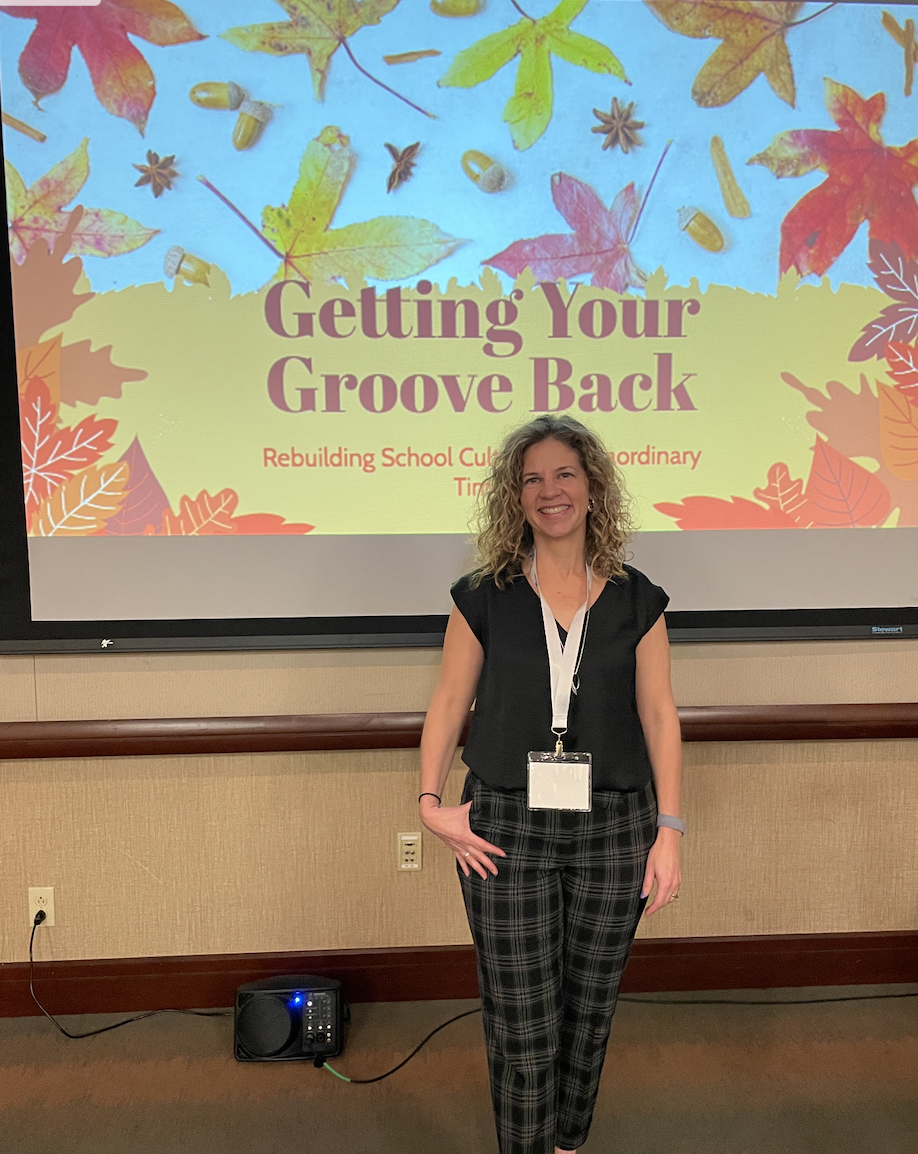
A great day in St. Louis presenting at the HOPE Montessori conference in 2023